


31 March 2026
why does sustainability matter in NHS uniform procurement?
Sustainability is no longer a nice-to-have in public sector procurement. It isn't a section you add to your website and brochures and then forget about. For NHS Trusts and large healthcare organisations, it has become a central requirement.
It is now built into policy frameworks, supplier assessments, and contract conditions. If you are responsible for uniform procurement within your Trust, the decisions you make about where and how you source garments now carry environmental and social obligations that go far beyond cost per unit.
The NHS in England spends around £23 million a year on uniforms alone. And the health service's supply chain accounts for around two-thirds of its total carbon footprint. So, even routine purchasing decisions, like choosing an NHS Healthcare Uniform supplier, become a meaningful opportunity to reduce environmental impact.
what is sustainable procurement and why is it important for the NHS?
Sustainable procurement is the process of meeting your organisation's needs for goods and services in a way that delivers value for money across the whole product lifecycle. However, it extends to doing this in a way that generates benefits for society and minimises damage to the environment. It means looking beyond the purchase price and considering how products are made. This includes where materials come from, what happens to garments at end of life, and whether your suppliers meet ethical and environmental standards.
For NHS Trusts and integrated care systems, the importance of sustainable uniform procurement is particularly acute. The NHS has committed to reaching net zero by 2040 for its direct emissions and by 2045 for those generated through its supply chain. These are not aspirational targets. They are backed by a structured supplier roadmap with milestones that are already influencing how contracts are awarded.

key milestones on the NHS net zero supplier roadmap
The NHS has set out a clear timeline for tightening sustainability requirements across its supply chain.
how the NHS Healthcare Uniform Framework is embedding sustainability
The rollout of the new NHS Healthcare Uniform is one of the most visible examples of sustainable procurement practices in action within the health service. The NHS Healthcare Uniform Framework was designed not just to standardise what around 600,000 clinical staff wear across England, but to set a higher bar for how those garments are sourced and manufactured.
Sustainability was written into the specification from the outset. The new NHS Healthcare Uniforms are constructed using 100% recycled polyester and cotton sourced through the Better Cotton Initiative. Suppliers on the framework are assessed against carbon reduction plans, the Evergreen Sustainable Supplier Assessment, modern slavery protocols, and social value commitments. This is what responsible procurement should look like. Environmental and ethical standards need to be treated as non-negotiable criteria.
For procurement managers considering the transition to the new NHS Healthcare Uniform, the framework offers a clear route to meeting your Trust's sustainability obligations while also delivering cost savings of 30% to 50% compared with individually procured uniforms. It eliminates the need for Trusts to run their own tendering processes, freeing up procurement resource while ensuring full compliance with UK procurement legislation.
)
key pillars of ethical and sustainable procurement in NHS uniform sourcing
Ethical and sustainable procurement in the context of NHS Healthcare Uniforms goes beyond selecting a garment made from recycled fabric.
-

sustainable sourcing and material transparency
-
carbon reduction and green procurement
-
social value and modern slavery prevention
-
circularity and end-of-life planning
practical steps for procurement managers
If you are reviewing your Trust's approach to uniform procurement and want to ensure it meets current and future sustainability requirements, here is where to start:
1. audit your current contracts
Review existing arrangements against the NHS net zero supplier roadmap milestones. Identify any gaps in supplier compliance, particularly around Carbon Reduction Plans and the Evergreen Assessment. Contracts that were awarded before 2024 may not include these requirements.
2. evaluate total cost of ownership
Look further than unit price. Durable, well-made garments that withstand frequent laundering reduce replacement cycles, generate less waste, and deliver better long-term value. A cheaper garment that needs replacing twice as often is not a saving.
3. interrogate supplier credentials
Engage directly with your suppliers on their sustainability performance. Ask for evidence of certifications, emissions data, and social value commitments rather than relying on self-reported claims. Transparency should be a baseline expectation.
4. consider the NHS Healthcare Uniform Framework
If your Trust has not yet explored the NHS Healthcare Uniform Framework, it offers a compliant, sustainable, cost-effective route to uniform provision at scale, without the burden of running your own tendering process.
5. weight sustainability in your scoring models
If environmental and social factors do not carry meaningful weight in your procurement decisions, they will continue to be secondary to cost. Build these criteria into evaluation frameworks so they drive real outcomes.
why leading NHS Trusts choose alsico for sustainable uniform procurement
As one of Europe's largest uniform manufacturers and the majority supplier on the NHS Healthcare Uniform Framework, alsico is trusted by the largest healthcare organisations in the UK to deliver NHS Healthcare Uniforms that meet the highest standards of quality, sustainability, and inclusivity.
Our approach to sustainable procurement is built into how we operate, not bolted on as an afterthought. We are GRS-certified, committed to the NHS net zero supplier roadmap, and actively investing in circular textile solutions through our arx and 3CL initiatives. We manufacture garments using 100% recycled polyester and sustainably sourced cotton, and we work closely with Trusts to ensure uniform provision supports their wider ESG commitments.
- GRS-certified manufacturing using 100% recycled polyester and Better Cotton Initiative cotton.
- Full alignment with the NHS net zero supplier roadmap, including Carbon Reduction Plan and Evergreen Assessment compliance.
- Circular textile solutions through arx and 3CL, covering care, repair, rework, and closed-loop recycling.
- Inclusive, culturally sensitive uniform ranges designed with input from frontline NHS staff.
- Dedicated implementation team to support Trusts through needs assessment, sizing, rollout, and ongoing supply.
We also understand that sustainability is only one part of a successful procurement decision. You can explore how other organisations have worked with us through our case studies.

If your Trust is exploring sustainable uniform procurement options, or considering adoption of the NHS Healthcare Uniform, our team can help you understand the framework, assess your requirements, and plan a smooth implementation.
healthcare environments we provide uniforms for
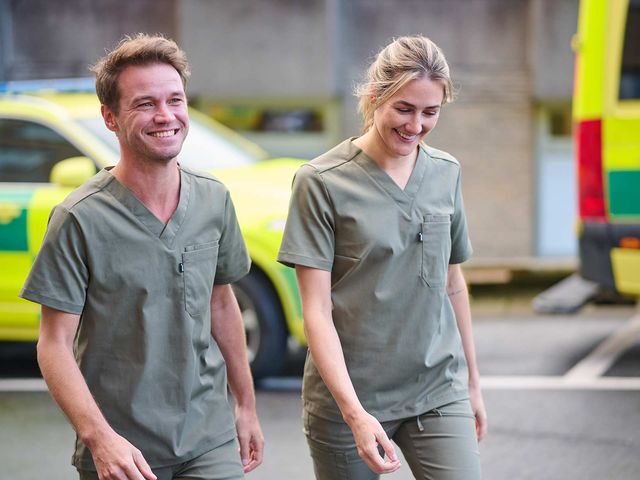
healthcare providers
Mobility, total hygiene and comfort. The high demands of an operating theatre are reflected one by one in our clean-air healthcare tunics and healthcare trousers.

healthcare science
From support areas to research labs, our healthcare garments uphold the highest standards, ensuring consistency and excellence throughout your healthcare sciences.

support services
Ensuring your entire operation is clothed in the very best, our workwear solutions for non-clinical areas ensure a consistent and high-quality result for your business.

business administration
Our range embodies a perfect blend of style and durability and meets the needs of the workplace environment. Experience the transformation our office wear solutions can bring to your role.

food services
Food preparation in a healthcare environment demands superior quality, high durability, and comfort for long shifts in the kitchens.

contamination control
When the height of safety is required, our healthcare garments for high-demand areas are made to perform.
contact us
