7 September 2026
How uniform management can support care home inspection readiness
The Care Quality Commission (CQC) assesses care homes against a broad set of quality expectations. For care providers, that means inspection preparation is not only about having the right policies in place, but also about showing that good practice is reflected in day-to-day operations.
Under the CQC single assessment framework, inspectors gather evidence from data, feedback, observation and documentation to build a wider picture of quality across the service.
Uniform is one small part of the wider picture, but your care home uniform policy can support areas such as infection control, staff presentation and consistent working practices across your homes. It is not a standalone procurement decision, and it should reflect the same standards you expect staff to follow day to day.
How uniform fits into CQC inspection preparation
Every CQC care home inspection is structured around five key questions: is the service safe, effective, caring, responsive, and well-led? Under the CQC single assessment framework, these questions are assessed through quality statements and six evidence categories, including people’s experience, observation, and processes.
For care home groups operating across multiple sites, the shift from the old Key Lines of Enquiry to the current framework has changed what ‘inspection-ready’ means. It is no longer about assembling a folder the week before a visit. Inspectors are looking for consistent, embedded practice. Evidence that standards are maintained over time, rather than staged for the day.
Infection prevention and control, staffing, safeguarding, medicines management and governance all form part of the wider assessment picture. Uniform fits within that broader context, particularly where it supports hygiene requirements, clear role identification and consistent working practices.
Care home infection control
Infection prevention and control fall under the ‘Safe’ key question and form an important part of a CQC care home inspection. Inspectors assess whether your home has an up-to-date IPC policy aligned with the Health and Social Care Act 2008 Code of Practice, whether staff understand and follow it, and whether the physical environment supports safe practice.
The CQC’s own IPC assessment tool for care homes explicitly references how laundry is managed, including staff uniforms. It asks whether there are clear procedures for handling contaminated clothing and whether laundering arrangements meet the required care home hygiene standards. If your staff are washing uniforms at home without documented guidance on temperature, handling and separation, that can leave a gap in how your laundering arrangements are managed.
A clearly documented care home uniform policy will contribute directly to your inspection readiness. The policy should set out whether uniforms are laundered on-site, at home, or through an external service. It should specify washing temperatures, state that uniforms must not be worn outside the workplace, and it should describe how contaminated garments are handled. These details help show whether your care home infection control arrangements are reflected consistently in day-to-day operations.
Bare below the elbows and what it means for uniform design
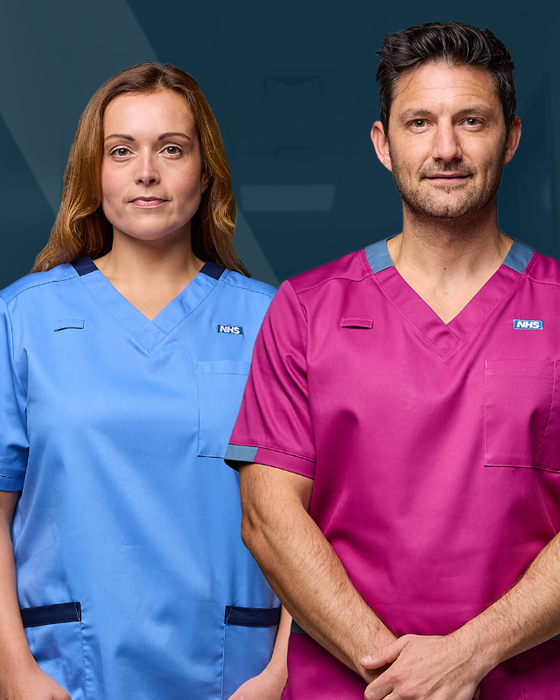
The bare below the elbows principle is a core component of infection control practice in care settings. It requires that staff delivering direct care have forearms clear of clothing, jewellery, and wristwatches to support effective hand hygiene. NHS England’s uniforms and workwear guidance reinforces this, and CQC inspectors observe it as part of their assessment.
For care home groups, this has a direct implication for the garments you specify. Tunics and tops must be short-sleeved as standard or designed so that sleeves can be securely rolled and held above the elbow during care tasks.
If your care home uniform policy does not explicitly reference bare below the elbows requirements, it should. And the garments procured need to support the policy, not work against it. This is a straightforward procurement specification, but it also needs to be reflected in day-to-day practice rather than existing only in your policy document.

Staff presentation and clear role identification
Clean, identifiable uniforms help staff present consistently and can make different roles easier for residents, families and colleagues to recognise. Stained, ill-fitting or inconsistent clothing can work against that clarity.
For large care home groups, visual consistency across sites also helps reinforce common expectations. If your homes use colour-coded uniforms to distinguish between nurses, care assistants, kitchen staff and housekeeping, the system should be clear and consistently applied.
In dementia care settings especially, consistent visual cues can help residents identify who is caring for them. The CQC considers the experience of people using the service as an evidence category, so clear role identification can form part of that wider experience.

Uniform details to include in CQC inspection preparation
Most care home groups invest heavily in the areas they know the CQC prioritises. These areas include care plans, medicines records, safeguarding protocols, and staff training logs. While these are all critical, smaller operational details can also affect how consistently those standards are applied day to day.

Uniform condition and replacement cycles
A documented care home uniform policy is important, but so is the condition and fit of the garments in use. Staff need clean, serviceable garments that fit properly, allow comfortable movement and work for the range of people in your workforce. An inclusive approach to sizing and fit can also help reduce the need for staff to adapt or work around clothing that was not designed with them in mind.
Replacement cycles should account for garment condition as well as cost, so staff are not left wearing clothing that is damaged, faded or no longer suitable for the role.

Footwear standards
Your care home inspection checklist should include footwear. Closed-toe, supportive, slip-resistant shoes can form part of a consistent approach to staff safety. If footwear standards form part of your uniform policy, they should be clearly communicated and followed in practice.

PPE availability and separation from uniform
Uniforms and personal protective equipment serve different functions, and your care home infection control procedures should reflect that. Gloves, aprons, and masks are task-specific protection. They are not substitutes for a clean, properly maintained uniform, and they are not part of the uniform itself. Inspectors look for evidence that PPE is readily accessible, correctly used, and disposed of appropriately.
Building uniform into your care home inspection checklist
If your group runs internal audits or mock inspections before a CQC visit, uniform should be a specific line item. A few practical checks can help you assess whether your uniform programme is being applied consistently across your homes:
- Are all staff in clean, correctly fitting uniforms at the start of each shift?
- Is the colour-coding system consistent and understood by staff, residents, and visitors?
- Are all care-facing staff bare below the elbows during direct care?
- Is the laundering process documented, with clear temperature and contamination handling procedures?
- Are staff wearing appropriate closed-toe, slip-resistant footwear?
- Is there a clear written policy that covers all the above?
- Are replacement cycles in place so that garments remain in good condition?
None of these are difficult to get right. But they do need to be specified, procured against, and maintained. If your uniform arrangements are informal or inconsistent across sites, it becomes harder to show that the same standards are being followed throughout the group.
How alsico supports well-managed care home uniform programmes
For large care home groups managing thousands of staff across multiple locations, a well-managed uniform programme needs to account for garment performance, fit, inclusivity, laundering requirements and consistent supply. The experience of the supplier behind that programme can help you manage those requirements across multiple sites.
Alsico’s care home uniforms are designed to maintain their performance across repeated industrial wash cycles, with short-sleeve designs that support bare below the elbows compliance as standard. ALSIFLEX® stretch fabric technology provides freedom of movement for care tasks, while inclusive sizing and design options ensure that your uniform works for your whole workforce.
As an awarded supplier under the NHS Healthcare Uniform Framework and a specialist in care home workwear, alsico works with large care providers and NHS Trusts to deliver uniform programmes that are consistent across sites, built for compliance, and designed around the people who wear them.
To discuss how alsico can support your care home group with a well-managed uniform programme for everyday care, get in touch with our team.